In today’s industrial landscape, voltage fluctuations are the silent killers of machinery. Whether you are running a massive manufacturing plant, a hospital with sensitive MRI machines, or a residential complex with luxury elevators, the quality of your input power dictates the lifespan of your equipment.
At Servo Megik Technology, we don’t just build stabilizers; we engineer confidence. With decades of experience in power conditioning, we have established ourselves as the premier servo stabilizer manufacturer in India.
But before you purchase your next stabilizer, it is crucial to understand the technology behind it. What is a servo stabilizer? Which type is best for your specific use case? And most importantly, how do you calculate your exact load requirement?
Let’s break it down.
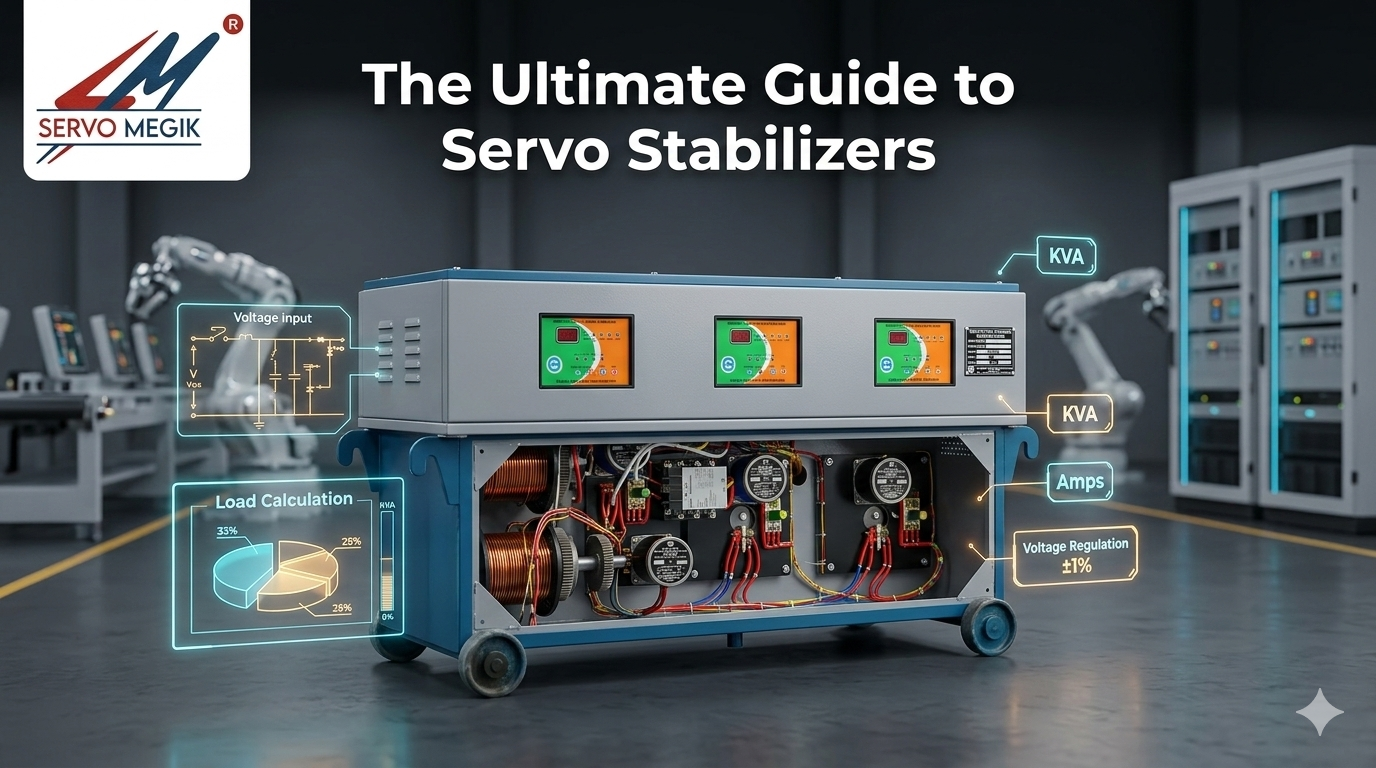
A servo voltage stabilizer is an electromechanical device designed to regulate output voltage. Unlike conventional relays or static stabilizers, a servo stabilizer uses a servo motor coupled with a variable auto-transformer to correct voltage fluctuations with high accuracy (typically ±1%).
In simple terms: If the grid supplies voltage that is too high or too low, the servo stabilizer instantly corrects it to a safe, consistent level, ensuring your equipment operates at peak efficiency.
There are primarily three types of stabilizers dominating the Indian market. However, not all are created equal.
Mechanism: Uses relays to switch between different transformer taps.
Pros: Cheap and lightweight.
Cons: Low accuracy, sparking risks, and no "servo" correction.
Best for: Low-budget home appliances (refrigerators, ACs).
Mechanism: Uses power electronic converters (IGBTs) to regulate voltage. No moving parts.
Pros: Instantaneous correction speed, silent operation.
Cons: Very expensive, sensitive to overloads and short circuits.
Best for: High-end research labs and specific medical equipment.
Mechanism: Uses a servo motor to move a carbon brush along a dimmer (transformer) to adjust voltage.
Pros: High accuracy, robust, handles heavy overloads easily, durable.
Cons: Slightly slower correction time than static (milliseconds vs. microseconds), but more than sufficient for 99% of industrial applications.
Best for: Industrial machinery, CNC machines, elevators, hospitals, and large residential complexes.
The answer depends on your application. At Servo Megik Technology, we advocate for air-cooled and oil-cooled servo stabilizers.
For Industrial Loads (CNC, Plastic Molding, Compressors): You need an air-cooled servo stabilizer. It is rugged, can handle momentary overloads, and is easy to maintain.
For High-Heat, Continuous Duty (Furnaces, Chemical Plants): You need an oil-cooled servo stabilizer. The oil dissipates heat faster, protecting the windings in extreme environments.
For Residential or Commercial Buildings: A standard servo stabilizer is the best choice. It protects elevators, HVAC systems, and water pumps far better than relay-based alternatives.
Our Verdict: If you value your machinery, never settle for relay stabilizers for industrial use. Servo stabilizers are the only reliable solution.
The biggest mistake buyers make is guessing the load. An undersized stabilizer will trip constantly; an oversized one is a waste of capital. You need precision.
Here is how to calculate your requirements, categorized by industry standard:
Single Phase (230V): Used for homes, small shops, and offices.
Three Phase (415V): Used for industries, large motors, and factories.
Check the nameplate of your machine or the main incoming breaker.
If the machine lists Current (Amps):
For Single Phase: KVA = (Voltage × Amps) / 1000
For three-phase: KVA = (Voltage × Amps × 1.732) / 1000
Example: A 3-phase motor running at 415V and drawing 50 amps requires (415 x 50 x 1.732) / 1000 = 35.9 KVA.
Never load a stabilizer to 100% of its capacity. Always add a 20-25% safety margin to account for future expansion and motor starting currents.
Calculation: 35.9 KVA + 25% = 44.8 KVA.
Recommendation: You should purchase a 45 KVA or 50 KVA servo stabilizer.
Many people confuse KW (Real Power) with KVA (Apparent Power).
KW is the actual power used.
KVA is the total power drawn (including reactive power).
Formula: KW = KVA x Power Factor (PF).
If your machine lists KW, convert it to KVA using the formula: KVA = KW / PF. If the PF is unknown, assume 0.8. For example, a 40 KW motor / 0.8 PF = 50 KVA.
In a market flooded with unorganized players and cheap imports, Servo Megik Technology stands as a beacon of quality and reliability. Here is why we are the preferred choice across India and beyond:
Uncompromised Quality: We use high-grade CRGO silicon steel cores and pure copper windings. While others cut corners with aluminum, we ensure maximum efficiency and lower running temperatures.
Made in India, Engineered for the World: Our manufacturing facility adheres to international standards. We don't just assemble parts; we design and manufacture our own transformers and servomotors, ensuring complete control over quality.
Precision Engineering: We guarantee an output voltage accuracy of ±1%. Our digital controllers are programmed to handle the toughest Indian grid conditions.
Customization: Need a 500 KVA oil-cooled unit with a specific IP rating? We don't just sell boxes; we provide custom-engineered solutions tailored to your site report.
Pan-India Service Support: We believe a product is only as good as the service behind it. With dedicated service engineers across India, we are always just a phone call away.
Selecting the right stabilizer is an investment in the longevity of your assets. By understanding your load calculation (kVA vs. amps) and choosing the correct type of servo technology, you safeguard your operations against unpredictable power.
Don't leave your machinery to chance. Trust the experts.
Contact Servo Megik Technology today for a free load consultation or to discuss your custom stabilizer requirements. Let us power your precision.

Their Oil Cooled Servo Voltage Stabilizer handles heavy loads perfectly. Great product and great team!


The Isolation Transformer we purchased has been extremely reliable for our hospital equipment. Highly satisfied.

Servo Megik’s Servo Voltage Stabilizer has eliminated our downtime issues. Excellent quality and prompt support!
Question and Answers
Commonly Asked Questions
What is the warranty period?
Typically 12–24 months, extendable depending on customer requirements.
Are they compliant with standards?
Yes, quality transformers comply with IS 1180, IEC, and ISO 9001:2015 standards.
What routine maintenance is required?
• Oil level and quality check (for oil-cooled models) • Insulation resistance testing • Checking bushings, connections, and cooling systems
What is the difference between Distribution and Power Transformers?
• Distribution Transformer: Operates at lower voltages, supplies end-users, and is designed for continuous load. • Power Transformer: Operates at higher voltages, used in transmission networks, designed for bulk power transfer.
What is vector group classification?
It defines the phase difference between primary and secondary windings (e.g., Dyn11, Yyn0). This is critical for parallel operation and system compatibility.
What is impedance in a Distribution Transformer?
Impedance is the opposition to current flow, expressed as a percentage. It affects fault current levels and voltage regulation.
Can they be customized?
Yes, transformers can be designed for specific KVA ratings, voltage ratios, cooling methods, and environmental conditions.
Where are Distribution Transformers used?
• Residential colonies and housing complexes • Commercial buildings and malls • Industrial plants and factories • Utility substations
What cooling methods are used?
• ONAN (Oil Natural Air Natural) • ONAF (Oil Natural Air Forced) • Dry-type (Air-cooled)
What is the standard rating range?
From 25 KVA up to 2500 KVA for most industrial and utility applications.
What is the efficiency of a Distribution Transformer?
Typically 95–98%, depending on design and load.
What is the difference between copper and aluminum windings?
• Copper: Higher efficiency, longer life, lower losses. • Aluminum: Cost-effective, lighter weight, but slightly higher losses.
What types are available?
• Oil-immersed transformers (ONAN/ONAF cooling) • Dry-type transformers (air-cooled, epoxy resin cast)
What are the main components of a Distribution Transformer?
• Core (usually laminated steel) • Windings (copper or aluminum) • Insulation system • Tank and cooling system (oil or air)
What is the typical voltage range?
Commonly, input ranges from 11 kV/22 kV/33 kV and many more, & output ranges from 400 V/230 V depending on the application.
Why is it important?
It ensures safe and efficient delivery of electricity to end-users, minimizing losses and protecting equipment.
What is a Distribution Transformer?
A Distribution Transformer is an electrical device that steps down high-voltage electricity from the power grid to a lower voltage suitable for residential, commercial, or industrial use.
What is the warranty period?
Typically 12–24 months, depending on manufacturer policy.
What standards do they comply with?
Quality Variacs comply with IEC and BIS standards, ensuring safety and performance.
Do they provide isolation?
No. Since input and output share the same winding, electrical isolation is not provided. For isolation, a separate isolation transformer is required.
Are Variacs safe to use?
Yes, but they must be operated within rated capacity. Overloading can cause overheating.
What is the difference between fixed auto transformers and variable auto transformers?
• Fixed auto transformer: Provides a constant step-up or step-down voltage. • Variable auto transformer: Provides adjustable voltage output with a movable brush.
Are they available in single-phase and three-phase?
Yes. Single-phase Variacs are common for labs and small equipment, while three-phase models are used in industrial setups.
Can Variable Auto Transformers be used for step-up and step-down?
Yes. Depending on the tap position, they can provide lower or higher voltage than the input.
What are common applications?
• Testing electrical equipment under different voltages • Motor speed control • Laboratory experiments • Industrial machinery requiring variable voltage • Audio equipment and lighting dimming
What are the advantages of using a Variac?
• Smooth voltage control (continuous adjustment) • Compact size compared to dual-winding transformers • High efficiency (low losses) • Cost-effective for voltage regulation
Why is it called “auto”?
Because the same winding acts as both the primary and secondary, automatically sharing part of the circuit.
How does a Variable Auto Transformer work?
It works on the principle of electromagnetic induction. A movable carbon brush slides across the winding, tapping different points to vary the output voltage smoothly.
What is the typical voltage range?
Most single-phase Variacs operate from 0 to 270 V AC output with a 230 V AC input. Three-phase models can handle higher ranges depending on design.
How is it different from a normal transformer?
Unlike conventional transformers with separate primary and secondary windings, a variable auto transformer uses one continuous winding for both input and output. This design makes it more compact and efficient.
What is a Variable Auto Transformer?
A variable autotransformer, commonly called a Variac, is a type of autotransformer that allows smooth adjustment of output voltage by varying the tap point on a single winding.
What is the warranty period?
Typically 12–24 months, extendable depending on customer requirements.
Are they compliant with standards?
Yes, quality isolation transformers comply with IEC, BIS, and ISO 9001:2015 standards, ensuring safety and reliability.
Do Isolation Transformers require maintenance?
Minimal maintenance is needed—regular checks on insulation, winding integrity, and cooling systems ensure long service life.
Are there different types of Isolation Transformers?
• Single-phase isolation transformers—for small equipment. • Three-phase isolation transformers—for industrial machinery. • K-rated isolation transformers—for nonlinear loads with harmonics.
Can Isolation Transformers be customized?
Yes, they can be designed for specific load capacities, frequency ranges, and noise suppression levels depending on industry needs.
What is the difference between an Isolation Transformer and a normal transformer?
• Normal transformer: Steps voltage up or down. • Isolation transformer: Provides electrical separation and safety, usually with a 1:1 ratio.
Where are they commonly used?
• Medical equipment (MRI, X-ray machines) • IT data centers and servers • CNC machines and industrial automation • Audio/video systems for noise-free performance
What are the key benefits of using an Isolation Transformer?
• Safety: Prevents accidental shocks. • Noise suppression: Filters electrical noise and harmonics. • Surge protection: Shields equipment from spikes and transients. • Improved power quality: Ensures a stable and clean supply.
What is the main advantage of this design?
It eliminates direct current paths, reducing risks of electric shock, noise interference, and surges.
How does an Isolation Transformer work?
It relies on magnetic induction: the primary winding creates a magnetic field, which induces voltage in the secondary winding without a direct electrical path.
Does it change voltage levels?
Typically, isolation transformers have a 1:1 turns ratio, meaning input and output voltage are the same. Their purpose is isolation, not stepping voltage up or down.
Why is it called “isolation”?
Because the primary and secondary windings are separated, ensuring no direct electrical connection. This provides safety and prevents electric shocks.
What is an Isolation Transformer?
An isolation transformer is a specially designed transformer that electrically isolates a device or system from the main power supply while still transferring AC power magnetically.
What is the warranty period?
Typically 12–24 months, extendable depending on customer requirements.
Are they compliant with standards?
Yes, quality stabilizers comply with ISO 9001:2015 and BIS standards, ensuring safety and reliability.
Do they require maintenance?
Minimal maintenance is needed—regular checks on wiring, connections, and cooling systems ensure long life.
What is the difference between Air-cooled and Oil-cooled models?
• Air-cooled: Compact, suitable for small/medium loads. • Oil-cooled: Heavy-duty, ideal for large industrial applications requiring continuous operation.
Can they be customized?
Yes, stabilizers can be designed for specific loads, input ranges, and environmental conditions.
Where are Servo Voltage Stabilizers used?
• Industrial: CNC machines, textile machinery, welding equipment • Commercial: IT data centers, hospitals, laboratories • Residential: Homes with sensitive electronics
What are the benefits?
• Protects sensitive equipment (medical devices, CNC machines, computers) • Reduces breakdowns and maintenance costs • Improves operational efficiency and productivity
What are the key features?
• High correction accuracy (±1%) • Overload & short-circuit protection • Continuous duty operation • Energy efficiency
What types are available?
• Air-cooled and Oil-cooled models • Single-phase and Three-phase stabilizers • Digital, Linear, and Manual types
What is the typical input/output range?
• Single Phase: Input: 160–260 V / 140–280 V / 90–270 V (can be customized), Output: 220/230/240 V (Single Phase) ±1% • Three Phase: Input: 270–460 V / 250–460 V / 150–460 V (can be customized), Output: 380/400/415 V (Three Phase) ±1%
How does a Servo Voltage Stabilizer work?
It uses a servo motor, buck-boost transformer, and control circuitry to continuously monitor input voltage and adjust output voltage to the desired level.
How is it different from a normal stabilizer?
Unlike basic stabilizers, servo stabilizers use a servo motor mechanism for precise voltage correction, offering higher accuracy and reliability.
Why is it needed?
It prevents damage to appliances and machinery caused by voltage variations, ensuring efficiency, safety, and longer equipment life.
What is a Servo Voltage Stabilizer?
A servo voltage stabilizer is an electrical device that automatically regulates voltage fluctuations to provide a stable output voltage, protecting sensitive equipment.


faq's
# Excellent Service
Plot No. A-11, KH No. 679, Sharad City, Opp. Loni Toll Plaza (Near Tronica City), Ghaziabad, Uttar Pradesh 201102